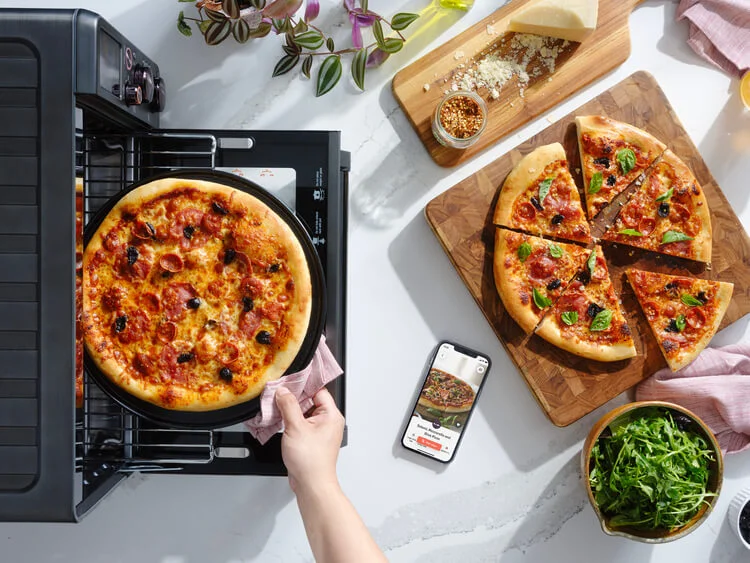
If your mouth wasn’t watering already, imagine taking that first delectable bite knowing that your creation was built by you—from the handmade pizza dough to the sauce to the baking precision. Now that’s amore.
To help you start, let’s break down everything you need to know about how to make homemade pizza dough from scratch.
What ingredients are in pizza dough?
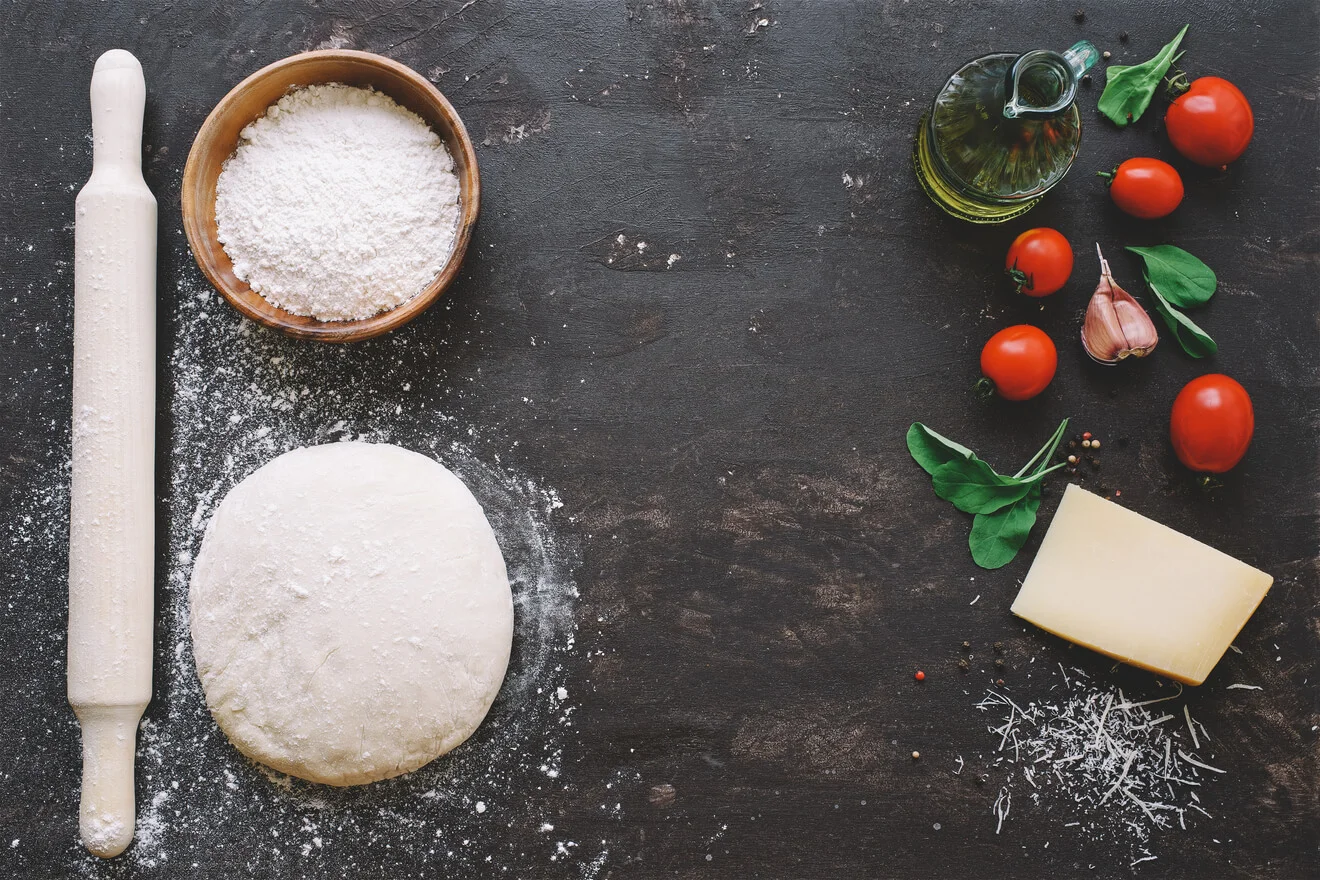
Despite pizza’s many variations and unique takes, for the most part, pizza dough is created with a similar methodology. To start, you’ll need to prep the five simple ingredients that make up the base:
● Water: 2 cups | 460g – The warmer your kitchen, the colder you want your water to be. Though it might take a little longer, cold water will give your dough a better rise.
● Salt: 3 tsp | 18g – Pizza chefs typically use finely ground sea salt, as it dissolves in water more evenly than coarse sea salt or kosher salt.
● Flour: 5 cups | 700g – If using all-purpose flour, know that it will be denser and have a stickier consistency, whereas bread flour is ideal if you’re looking for a chewier, airier pizza.
● Yeast: 0.5 tsp | 2g instant/1.5g active – Instant and active yeast yield similar results, but instant yeast keeps your dough longer.
● Oil: 2 tsp | 10g – Many oils hydrate the dough and give it a distinct flavor, but olive and extra virgin olive oil are the gold standards for making pizza dough.
Despite the simplicity of ingredients, this doesn’t mean creativity is out the window when it comes to your favorite pizza oven recipes. In fact, as with any type of creativity, the more limitations, the more room for new ideas.
Try slightly adjusting the amounts of each ingredient to identify your perfect blend. Then, consider additional ingredients such as garlic powder, dried basil leaves, oregano, or rosemary-infused oil.
Does the order of ingredients matter?
When learning how to make pizza dough, know that the order you mix certain ingredients is essential. With all your ingredients at the ready, it’s time to roll up your sleeves, grab a giant mixing bowl, and get your hands dirty:
● Step 1: Stir the salt and water in a large bowl until the salt has completely dissolved and there’s no more sediment at the bottom.
● Step 2: Slowly add flour into the water, stirring to reduce the chunks. At about the halfway point, go ahead and mix in your instant yeast as well. With everything mixed, you’ll want to allow this to sit for about 15 to 30 minutes.
● Step 3: Next up, you’ll incorporate the oil into the homemade pizza dough mixture. Use half of the oil to begin the kneading process. Once the oil has been soaked into the dough, then use the second half of the oil and continue kneading until it’s been evenly massaged. Then, cover the mixture and let it rest for 5 minutes.
● Step 4: Spread a light amount of flour on a flat kneading surface. Remove your mixture and knead the mixture on the flour until the texture is smooth and bouncy. This should be about 3 to 5 minutes. Then, cover the dough while you apply a light touch of oil to the storage containers.
● Step 5: Split the mixture into 4 equal pieces and roll them into a tight ball. Add each dough ball to one of your containers, lightly cover with a cloth and then refrigerate for 1 to 4 days.
● Step 6: On pizza night, remove your dough from the fridge and allow about 2 to 3 hours for the dough to get to room temperature before use.
Can I freeze my leftover pizza dough?
Since the yeast in homemade pizza dough makes it alive, it has a limited shelf life. A pizza dough recipe like the one above can make four 12” pizzas, but each dough ball will have a refrigerator shelf life of up to four days. You won't consume all you've made unless you create multiple pizzas for your friends or family.
After you’ve put your dough in your oiled storage container, put the excess in the freezer. Once you’ve got a frozen dough, you can remove it from the container and cover the ball in plastic wrap for up to three months. When ready, let the frozen pizza dough thaw in the refrigerator for 24 hours.
How do I stretch the dough?
After your homemade dough has been sitting out for a few hours and is at room temperature, it’s time to stretch it into a pizza crust. Don’t worry, you won’t need to toss the dough in the air like the professionals.
Once your dough has come to room temperature:
● Remove the cloth and lightly sprinkle flour on and around the homemade dough while it’s in its container. Also sprinkle flour across your stretching surface.
● Flip the container and allow gravity to bring the dough onto your stretching surface.
● With the base of your palms, slowly push the dough out from the center of the dough to the outside edge. Try to evenly distribute the dough to the best of your ability.
● Once it’s spread out, gently flip the dough and repeat this process. Once satisfied, flip it once more (this ensures a nice even layer of flour on both sides of the dough).
● With your fingers, press the edges of the dough into a crust to define the shape of your pizza.
For a more advanced technique, you can pick the dough up and hold them with your knuckles from beneath. By rotating the dough along your knuckles, slowly turning it in a circle, you’ll create a smooth, circular pizza dough that’s ready for your sauce and topping.
Cooking homemade pizza with Breville
Now that you know how to make homemade pizza dough, it’s time to find the right types of pizza ovens for your unique style. Whether you like thick crust, thin crust, soft and chewy, or crispy and crunchy, we’ve got you covered with our smart pizza oven, the Pizzaiolo. The baking process is just as important as the five essential components of pizza dough. With the Pizzaiolo, you’ll ensure a delicious finished meal from starter dough to first bite. For even more tips and guided recipes to use with your oven, check out Breville+.
You bring the ingredients and the imagination, and Breville will bring the innovation to help you master every moment.
Sources:
1. Scott’s Pizza Tours. Pizza Making Tips. https://www.scottspizzatours.com/pizza-hq/pizza-making/
2. Sugar Spun Run. The Best Pizza Dough Recipe. https://sugarspunrun.com/the-best-pizza-dough-recipe/
3. Bob’s Red Mill. What is Proofing? https://www.bobsredmill.com/blog/baking-101/what-is-proofing/